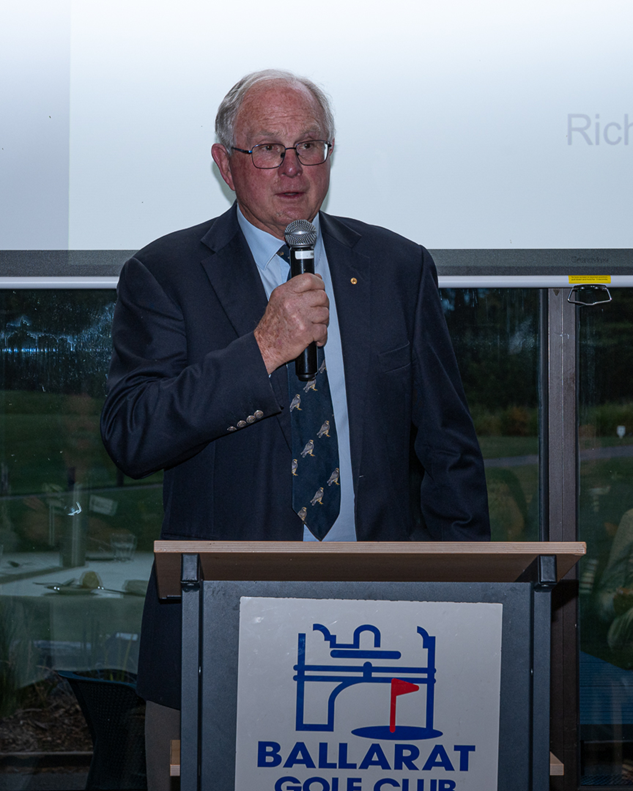
The participants of SEANA 2025 Spring Camp were privileged to have an evening presentation given by Richard Weatherly OAM. He is a well-known ornithologist, artist, regenerative farmer, and community activist. He studied history at Cambridge University and has spent “over 50 years studying, painting and writing about birds”.
Richard has managed a pastoral property near Mortlake in Western Victoria for over 40 years and has been deeply involved in creative landscape-scale revegetation projects on his farm and further afield. He has been acutely aware of the need for connectivity between natural and restored ecosystems.
Richard told the participants about his early family history which began six generations of his family farming two properties near Mortlake. Farming in the 1800s presented many practical challenges which covered the hazards of fire, flood, drought, pests and poor prices at different times. The most amazing part of this story was the commitment over generations to record wildlife on the farm, and birds in particular. The diaries record the time of year and the species of birds observed. This has become a valuable data-set created by one family on one farm over a very long time. Richard indicated that bird identification resources were very limited as no-one had produced specialised and authoritative bird books in early years. Richard himself managed to photograph many of the birds he observed – no mean effort.
One of the triggers for Richard to embrace ideas of sustainable farming, and an environmentally sensitive approach, was his experience as a land manager in having to deal with a 20-year long drought. He observed much damage in the landscape caused by degradation of pastures, river frontages, and the Hopkins River (which ran through the farm) itself. He believed that there had to be a better way. Richard observed that the bird populations that he valued so much had also been impacted by serious drought conditions.
He applied for and received financial assistance from, at least, the Glenelg Hopkins Catchment Management Authority to fence livestock out of the Hopkins River and to protect the riparian zone. This allowed the river frontage and the Hopkins River to begin to heal. With his family and farm staff, he double-fenced farm paddocks to allow for revegetation to create windbreaks and wildlife corridors. He carried out earthworks to manage the movement of water on the farm to create wetlands and to rehydrate the farm. To facilitate an efficient and rapid revegetation technique, Richard worked with others to develop and build a direct seeding machine which could be drawn behind a tractor. This allowed for significant areas to be seeded and covered in trees and shrubs very quickly. The initial plantings are now decades old and are a contributing habitat for many species. New and enhanced wetlands attract large numbers of water birds, including the iconic brolgas that regularly nest there.
Richard strongly believes all the environmental work on his farm, and pasture improvement, have increased the sustainability and resilience of the farm business. Over his time as farm manager, he has observed dramatic changes in bird populations in particular. He has seen the number of bird species recorded increase from approximately 170 to 240, and an associated increased activity in total numbers of all birds. Richard has also recorded changes in bird species, citing Rainbow Lorikeets and Short-billed Corellas as examples of species that have become far more common in his time.
A lifetime living in and around wildlife has clearly inspired Richard Weatherly to become a well-known and well-loved artist, representing birds as we all love to see them – in the wild.
Many thanks, Richard Weatherly, for a window into one man’s passion.
ABN 23 918 778 150
Incorporation No A0044963D