
Saturday afternoon.
Leader: Peter Turner
Facilitator: Sue Luke
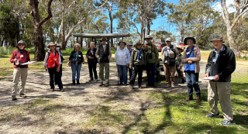
Our group of 16 participants was met by Sam Pollard, Ranger Team Leader, Castlemaine, Parks Vic. Some 80% of Mount Alexander Regional Park (Leanganook) was heavily impacted by a bushfire on 9 th January 2026 – a day of Catastrophic fire danger. The fire started several km north of Harcourt, spread quickly south across the hills before a wind change blew it over the Calder Fwy into Harcourt. About 50 homes, orchards and critical storage infrastructure was destroyed. Sam noted the fire reached the northern part of the mountain from private land, so control was initially managed by the CFA. Extreme weather conditions prevented early deployment of helicopters for air attack. The north area of Leanganook was severely burnt, with intense heat killing many mature trees and destroying radio and television transmission facilities.
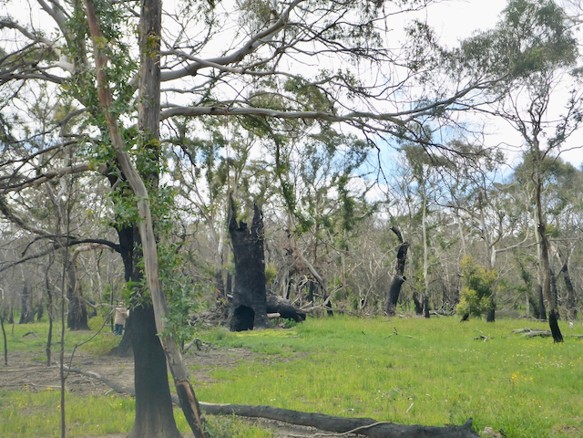
Sam described methods used by FFMV and Parks Vic to control fire within the Park – initially control lines were bulldozed within Park boundaries, then aerial water and fire-retardant ‘bombing’, followed by manual rake-hoeing to remove fuel loads near habitat trees and infrastructure in the southern area surrounding the popular Leanganook Campground. This saved many hollow-bearing trees in the southern area. Fire-retardant only smothers burning matter, so fire breakouts occurred. Tree risk assessments and mitigation works were undertaken by authorities during/after the fires, and it was several weeks before public vehicles could access Joseph Young Drive. Walking tracks recently opened after an extensive number of damaged.
Sam pointed out that the critically endangered Southern Shepherd’s Purse Ballantinia antipoda is found only within Leanganook at just a few sites with moss mats on rock faces. Key threats include climate change drying and warming of these moss mats, also disturbance by fauna and humans. Ballantinia antipoda is an annual with its seed bank held in the moss. Its future is even more uncertain now than before the fire.
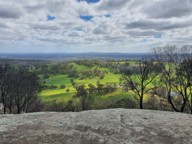
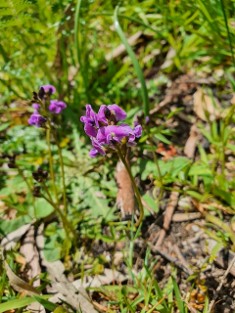
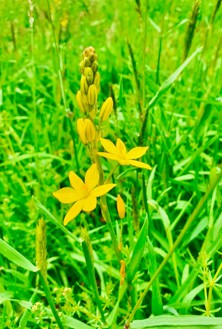
Leanganook is dominated by Manna Gum and the fallen branches previously limited off-track access and views of the terrain. The fire has left the woodland more open, and this was noted during our leisurely walk out to Cockatoo Rocks, where we enjoyed breathtaking views. From the beginning of the walk we were all delighted by the extensive patches of flowering native herbs – Chocolate Lily, Rice Flower, Milkmaids, Tall Sundew, Bulbine Lily. Other native species included Prickly Starwort, Austral Bugle, Waxlip Orchid and Showy Violet. CFNC members familiar with the area had never seen such a widespread and vigorous display. Understorey regrowth observed also included numerous weed grasses and forbs.
Bird list (Sue Luke and John Petheram)
| Noisy Miner | Laughing Kookaburra |
| Yellow-faced Honeyeater | Sulphur-crested Cockatoo |
| Little Corella | Crimson Rosella |
| Eastern Rosella | Grey Currawong |
| Striated Pardalote | Grey Fantail |
| White-throated Treecreeper | Flame Robin |
| Butterfly – Caper White |
Plant list (Sue Luke, John Petheram, Peter Turner)
| Manna Gum Eucalyptus viminalis | Blackwood Acacia melanoxylon |
| Cherry Ballart Exocarpos cupressiformis | Chocolate Lily Anthropodium strictum |
| Milkmaids Burchardia umbellate | Tall Sundew Drosera auriculata |
| Showy Violet Viola betonicifolia | Prickly Starwort Stellaria pungens |
| Twining Fringe-Lily Thysanotus patersonii | Austral Bugle Ajuga australis |
| Bulbine Lily Bulbine bulbosa | Waxlip Orchid Glossodia major |
| Early Nancy Wurmbea dioica | Sticky Everlasting Xerochrysum viscosa |
| Slender Rice-flower Pimelea linifolia | Common Sheep’s Burr Acaena echinata |
| Weeds | |
| Angular Pea Lathyrus angulatus | Proliferous Pink Petrorhagia nanteuilii |
| Small Medic | Common Shepherds Purse |
| Common Bartsia Bellardia latifolia | Cape Weed |
| Dandelion | Spear Thistle |
| Plantain | Onion Grass |
| Centaury | Numerous annual grasses |
ABN 23 918 778 150
Incorporation No A0044963D