
Saturday morning
Leader: Kerrie Jennings
Facilitator: Euan Moore
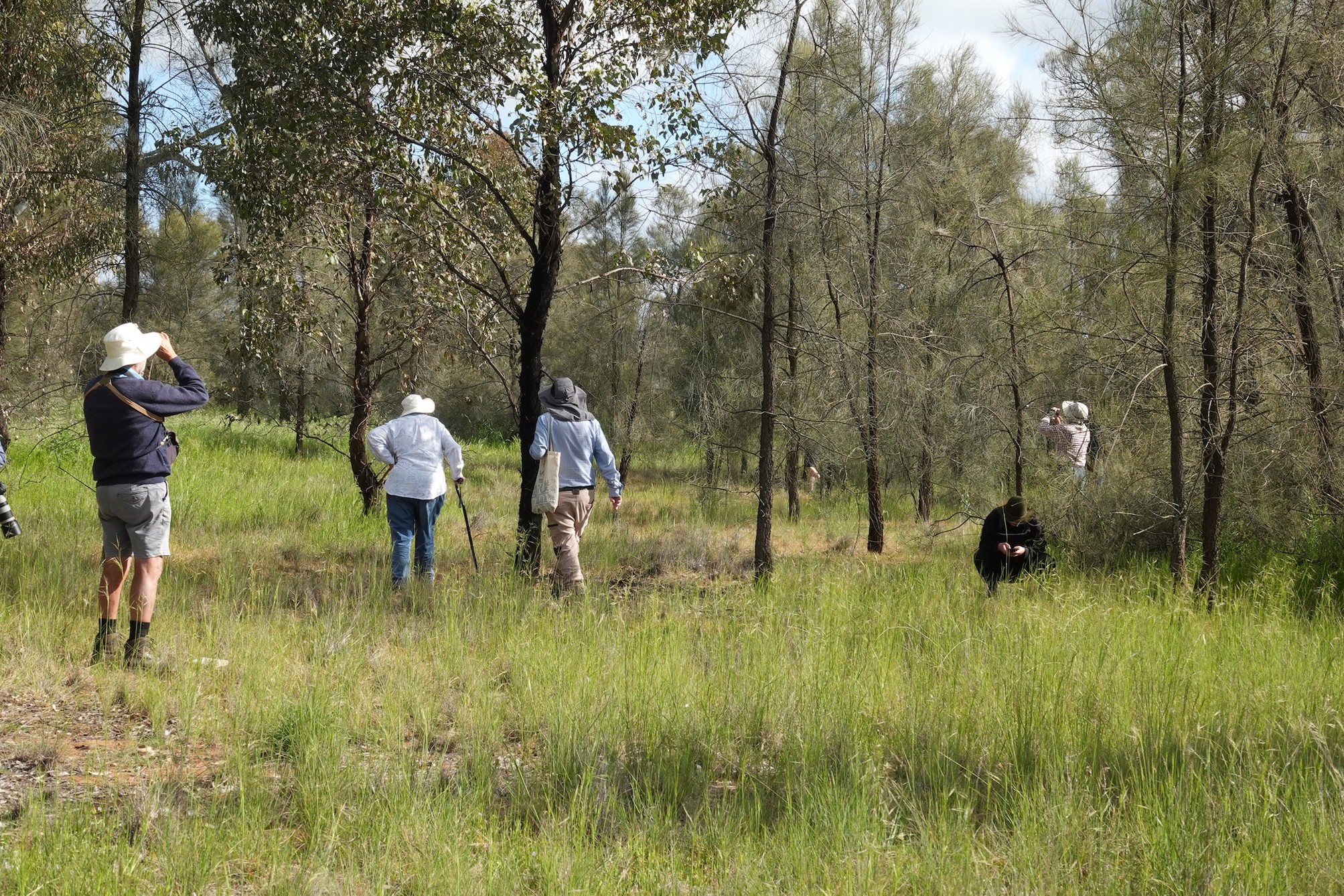
The group of 18 guests met at Baringhup then drove north to a private property on the Moolort Plains where we were met onsite by the property owner, Roy, who told us about the history of the property and described how most of the surrounding land has now been converted to cropping. This block of around 20Ha has been owned by one family for several generations and has never been cleared. The vegetation is Grey Box / Buloke grassy woodland The soils are a red loam derived from basalt. This is on a northern extension of the Western Victorian Volcanic Plain.
Bulokes are listed as Critically Endangered in Victoria. Buloke grassy woodlands are listed as endangered under the EPBC act with much less than 1% of their original extent remaining. This remnant was old-growth Buloke and Grey Box. Some of the Bulokes were up to 75cm diameter.
After hearing about the area, the group spread out to see what they could find. Parts of the area had been invaded by introduced grasses such as wild oats however there were areas of native grasses beneath the Bulokes. Native herbs were found amongst the grass and the rare Buloke Mistletoe (Critically Endangered) was found on a couple of mature Bulokes. This mistletoe can be hard to find unless it is in flower as the foliage blends in with the stems of the host plant. Unfortunately we were too early in the season for it to be flowering.
There was an abundance of birds in the woodland which was a contrast to the surrounding wheat and canola crops. Several groups of Red-rumped Parrots were feeding on the ground. Rufous Songlarks were very vocal and Dusky Woodswallows were nesting in one of the Grey Box.
Roy had previously been captain of the local CFA volunteers. In that role, in 2021, he had coordinated an ecological burn of roadside grasslands. He described what was involved and the difficulties in coordinating government agencies, council and private land holders. Largely due to the organisational complexity this ecological burn has not been attempted since.
On our way back to the meeting point we stopped at a ‘significant roadside area’. This was the area where the ecological burn had been carried out and we were shown photos of the burn in progress. While dominated by weedy grasses, the site had Spiny Rice-flower, Pimelea spinescens ssp spinescens growing between the road and the private property boundary. This is another critically endangered plant that was once found across the volcanic plains but is now restricted to isolated remnants on lowland grasslands.
Native plants recorded
| Austrostipa spp. | Spear grass – at least 3 species | Xerochrysum viscosum | Sticky Everlasting |
| Allocasuarina luehmannii | Buloke | Crassula sieberiana | Stonecrop |
| Amyema pendula subsp. Longifolia | Buloke Mistletoe | Convolvulus angustissimus | Australian bindweed |
| Eucalyptus macrocarpa | Grey Box | Rumex brownii | Slender Dock |
| Pimelea spinescens ssp spinescens | Spiny Rice-flower |
Butterflies recorded
| Belenois java | Caper White |
| Danaus petilia | Australian/Lesser Wanderer |
Mammals recorded
| Macropus giganteus | Eastern Grey Kangaroo |
Birds recorded
| Chenonetta jubata | Australian Wood Duck | Ptilotula penicillata | White-plumed Honeyeater |
| Falco berigora | Brown Falcon | Artamus cyanopterus | Dusky Woodswallow nesting |
| Eolophus roseicapilla | Galah | Gymnorhina tibicen | Australian Magpie |
| Cacatua tenuirostris | Long-billed Corella | Colluricincla harmonica | Grey Shrikethrush |
| Psephotus haematonotus | Red-rumped Parrot | Rhipidura leucophrys | Willie Wagtail |
| Climacteris picumnus | Brown Treecreeper | Corvus mellori | Little Raven |
| Malurus cyaneus | Superb Fairywren | Cincloramphus mathewsi | Rufous Songlark |
ABN 23 918 778 150
Incorporation No A0044963D