
Saturday afternoon
Leader: Beth Mellick
Facilitator: Lou Citroën
Focus: Flora, birds, the consequences of ‘fuel-reduction burns’ and the legacy of European gold mining.
This excursion was selected as a locally very popular part of Muckleford State Forest, with its abundant birdlife and native flora. Ever present is the remnant legacy of almost 150 years of mining and the devastation that has wrought on the entire environment several times over. The Red, White and Blue Mine was named after the colours of a flag raised to mark the first shaft sunk in 1871 into the gold-rich reef beneath.
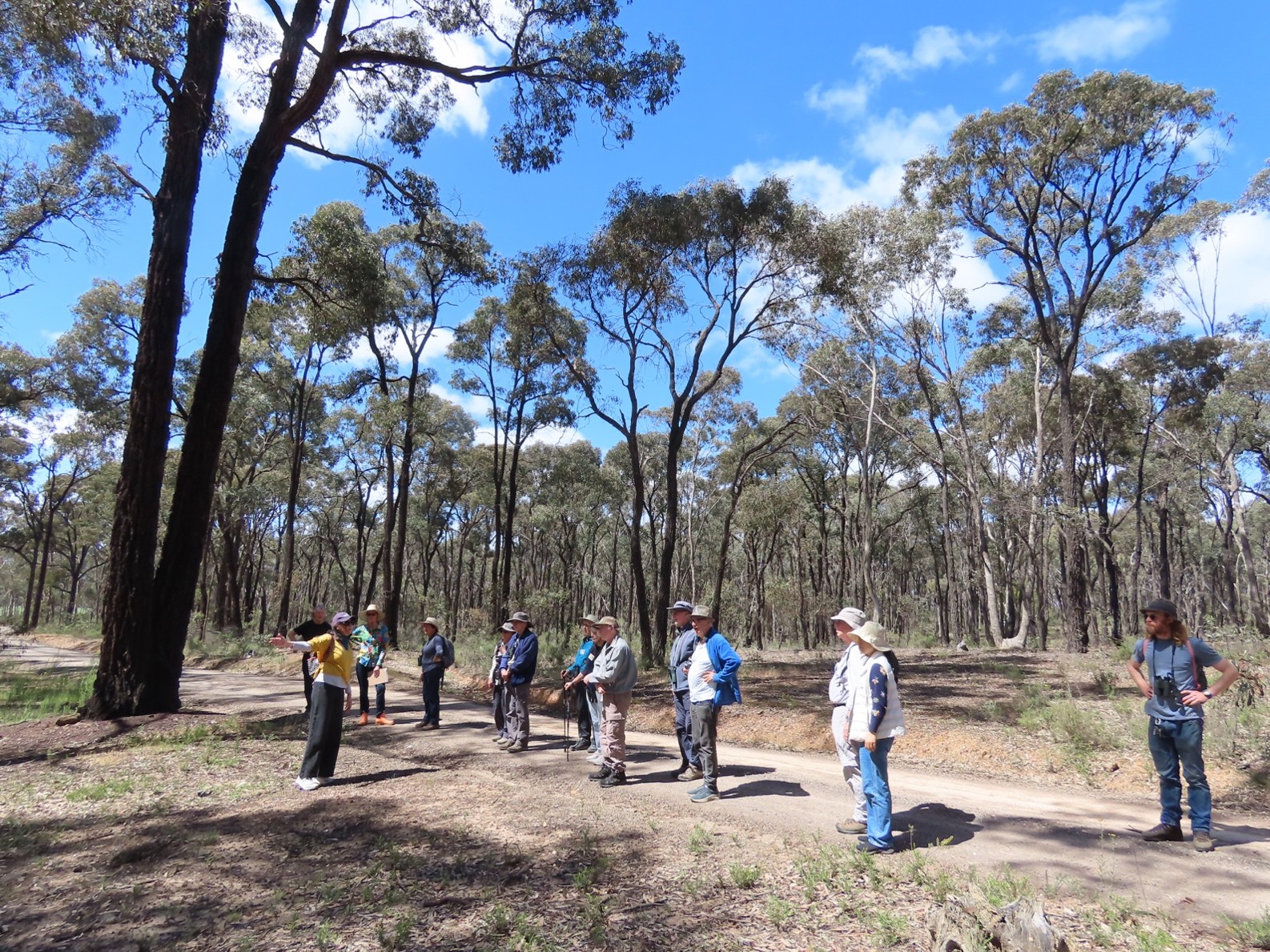
The walk was a comparatively easy, if somewhat long, 5 km walk, via Bells Lane Track, Talbot’s Track, Dunn’s Reef Track (including the old Dunn’s Reef mining site), Red White and Blue Track, through box and ironbark regrowth forest which was teeming with wildflowers and birdlife. As we made our way around, there were stops at a few locations where our leader, Beth, pointed out evidence and the consequences of controlled burns; comparing burnt and unburnt sites. The wash of colours from the diversity of breath-taking flora was visible in every direction and greatly enjoyed by the group. 40 native flora species were identified by the citizen scientists.
With a little extra effort, we climbed to the Dunn’s Reef site to see the entrance to the old mine shaft, the remains of an old loading ramp, and an opportunity for some to climb to the top to take in a grand view of the forest and beyond. The 2¼ hr walk concluded at the large unnamed dam adjacent to the picnic area. On this occasion, no birdlife was evident on the dam to add to the 24 bird species heard or seen by the group. A key observation at a number of locations was the visible loss of middle storey vegetation resulting from ‘controlled burns’.
Plant list:
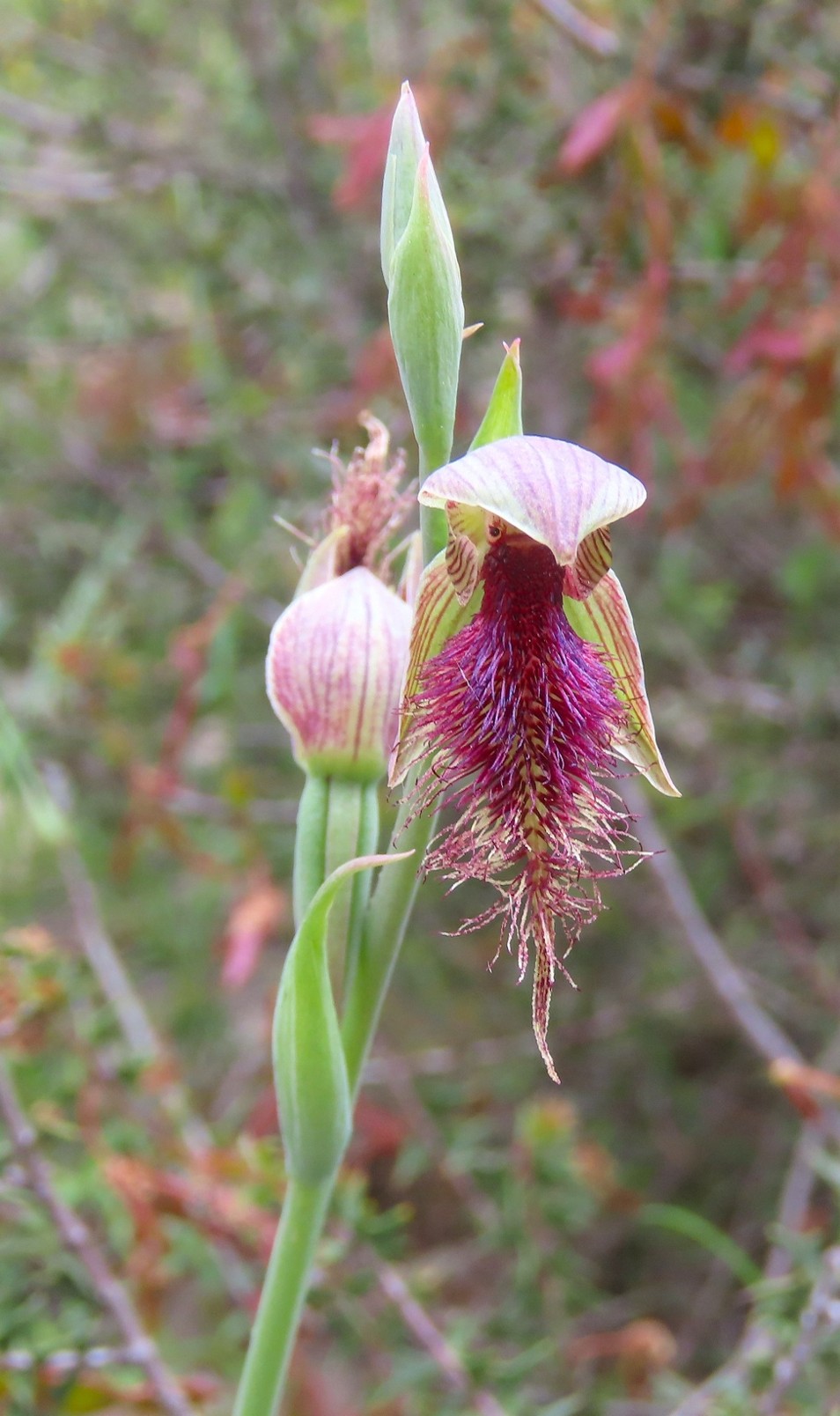
| Billy Buttons | Craspedia variabilis | Purplish Beard-orchid | Calochilus robertsonii |
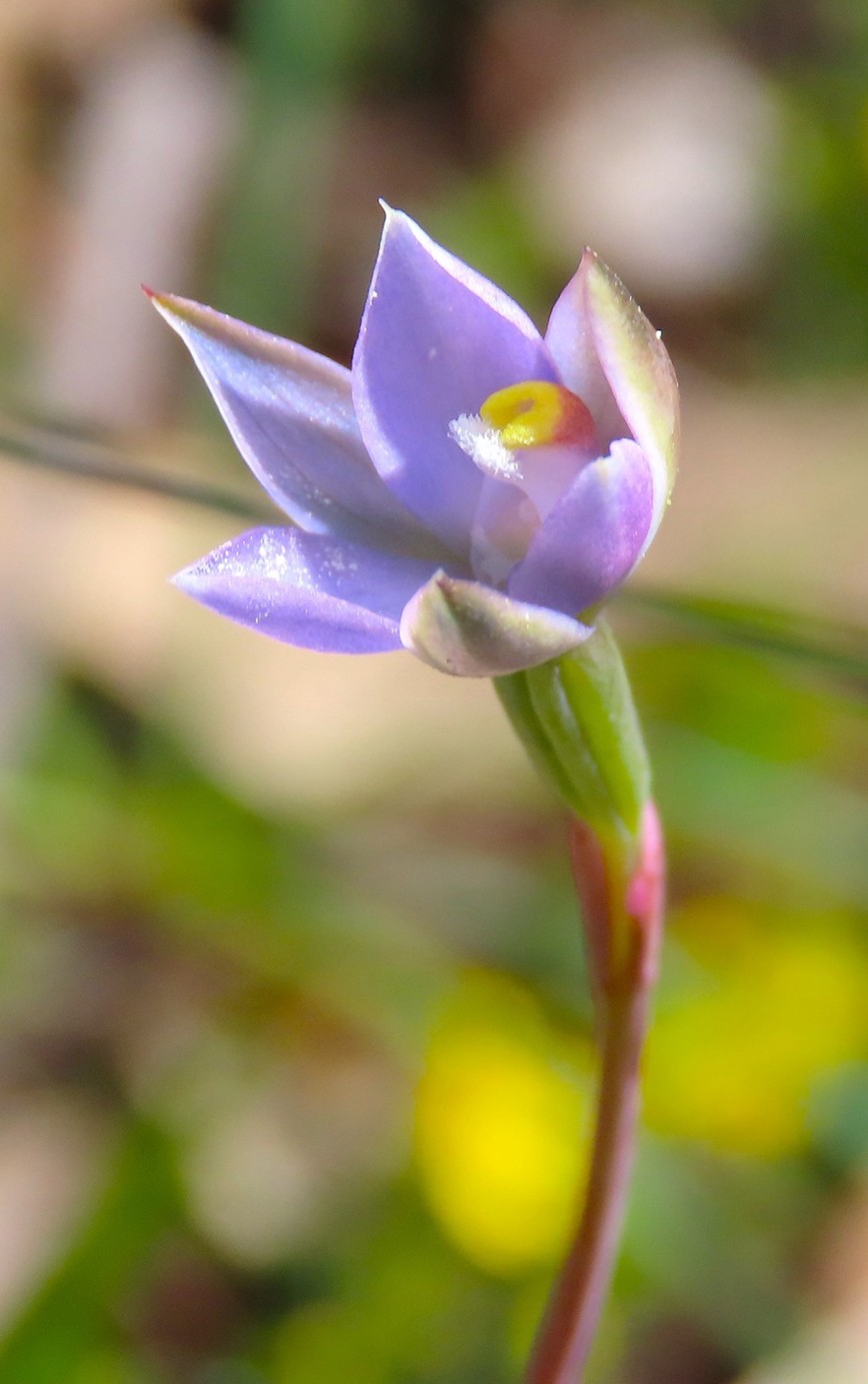
| Black-anther Flax-lily | Dianella revoluta | Rabbit’s Ear Orchid | Thelymitra antennifera |
| Bluebells | Wahlenbergia gracilenta | Salmon Sun Orchid | Thelymitra rubra |
| Chocolate Lily | Arthropodium strictum | Scented Sun Orchid | Thelymitra megcalyptra |
| Creamy Candles | Stackhousia monogyna | Scented Sundew | Drosera aberrans |
| Daphne Heath | Brachyloma daphnoides | Showy Parrot-pea | Dillwynia sericea |
| Downy Grevillia | Grevillia alpina | Showy Podolepis | Podolepis jaceoides |
| Gold Dust Wattle | Acacia acinacea | Slender Rice-flower | Pimelea linifolia |
| Golden Wattle | Acacia pycnantha | Spear Grass | Austrostipa species |
| Grass Trigger-plant | Stylidium graminifolium | Spiky Guinea-flower | Hibbertia exutiacies |
| Grey Everlasting | Ozothamnus obcordatus | Spreading Wattle | Acacia genistifolia |
| Grey Parrot-pea | Dillwynia cinerascens | Sticky Everlasting | Xerochrysum viscosum |
| Honeypots | Acrotriche serrulata | Stinking Pennywort | Hydrocotyle laxiflora |
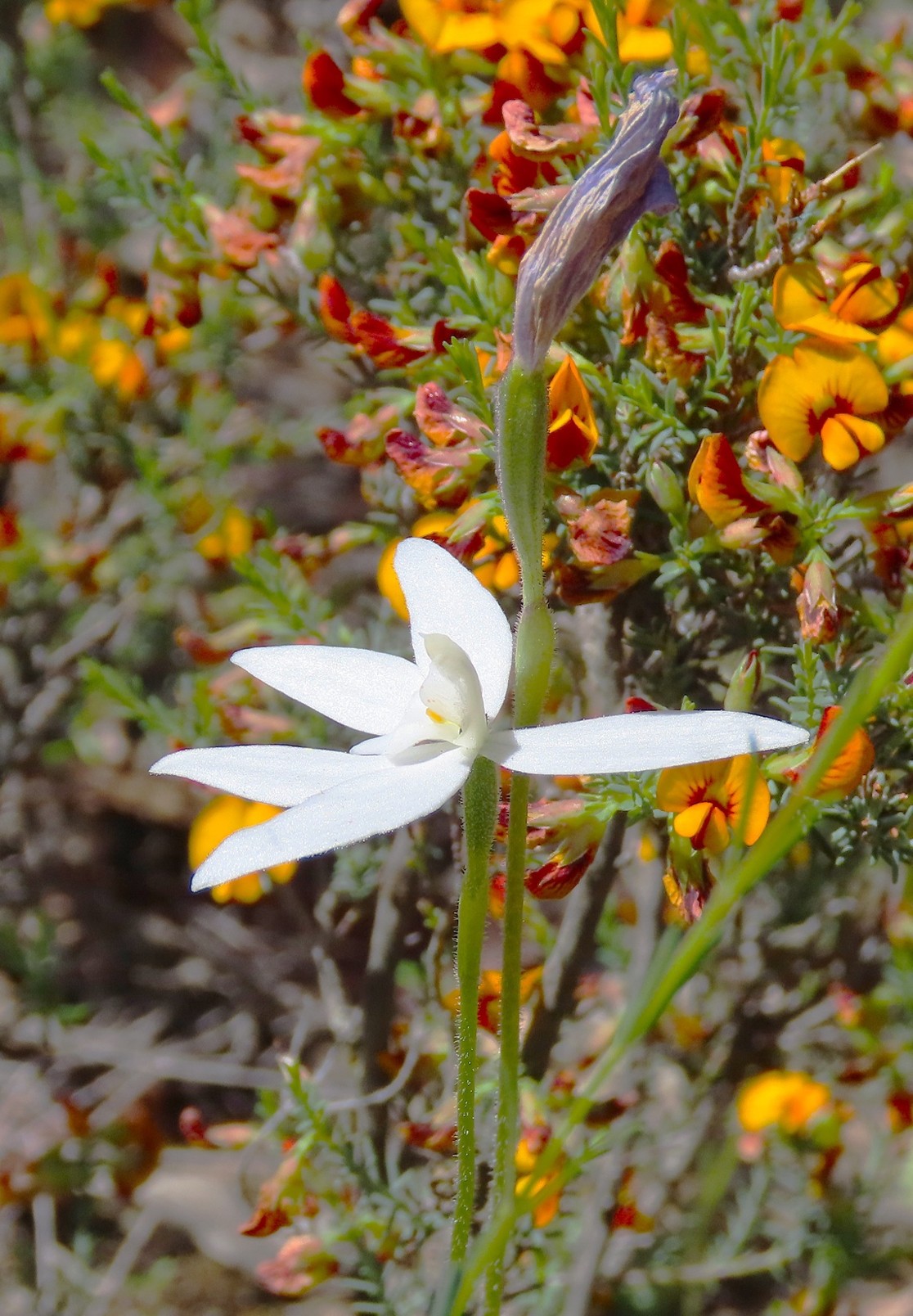
| Hooded Caladenia | Caladenia cucullata | Swan Greenhood | Pterostylis cycnocephala |
| Magenta Stork’s-bill | Pelargonium rodneyanum | Tall Sundew | Drosera auriculata |
| Many-flowered Mat- rush | Lomandra multiflora | Twining Fringe Lily | Thysanotus patersonii |
| Milkmaids | Burchardia umbellata | Twining Sundew | Drosera macrantha |
| Musky Caladenia | Caladenia gracilis | Wax-lip Orchid | Glossodia major |
| Nodding Greenhood | Pterostylis nutans | White Marianth | Rhytidosporum procumbens |
| Pink Bells | Tetratheca ciliata | Yam Daisy (Myrnong) | Microseris walteri |
Bird list:
| Peaceful Dove | 2 | Red Wattlebird | P | Crested Bellbird | 1 |
| White-necked Heron | 1 | Yellow-faced Honeyeater | P | Grey Currawong | 2 |
| Galah | 6 | Spotted Pardalote | 2 | Grey Fantail | 2 |
| Crimson Rosella | 4 | Striated Pardalote | 2 | Australian Raven | 6 |
| White-throated Treecreeper | 3 | Weebill | 6 | White-winged Chough | 4 |
| Superb Fairy-wren | P | Brown Thornbill | P | Scarlet Robin | P |
| White-eared Honeyeater | 2 | Rufous Whistler | P | Jacky Winter | 1 |
| Brown-headed Honeyeater | 2 | Grey Shrike-thrush | 2 | Mistletoe bird | P |
ABN 23 918 778 150
Incorporation No A0044963D